Types of factoring
Factoring isn't a single product. There are several types of factoring, and each one suits a different kind of business. Here's how they work and which one fits your company.
Book a no-obligation consultation
The first conversation is free, with no obligation.
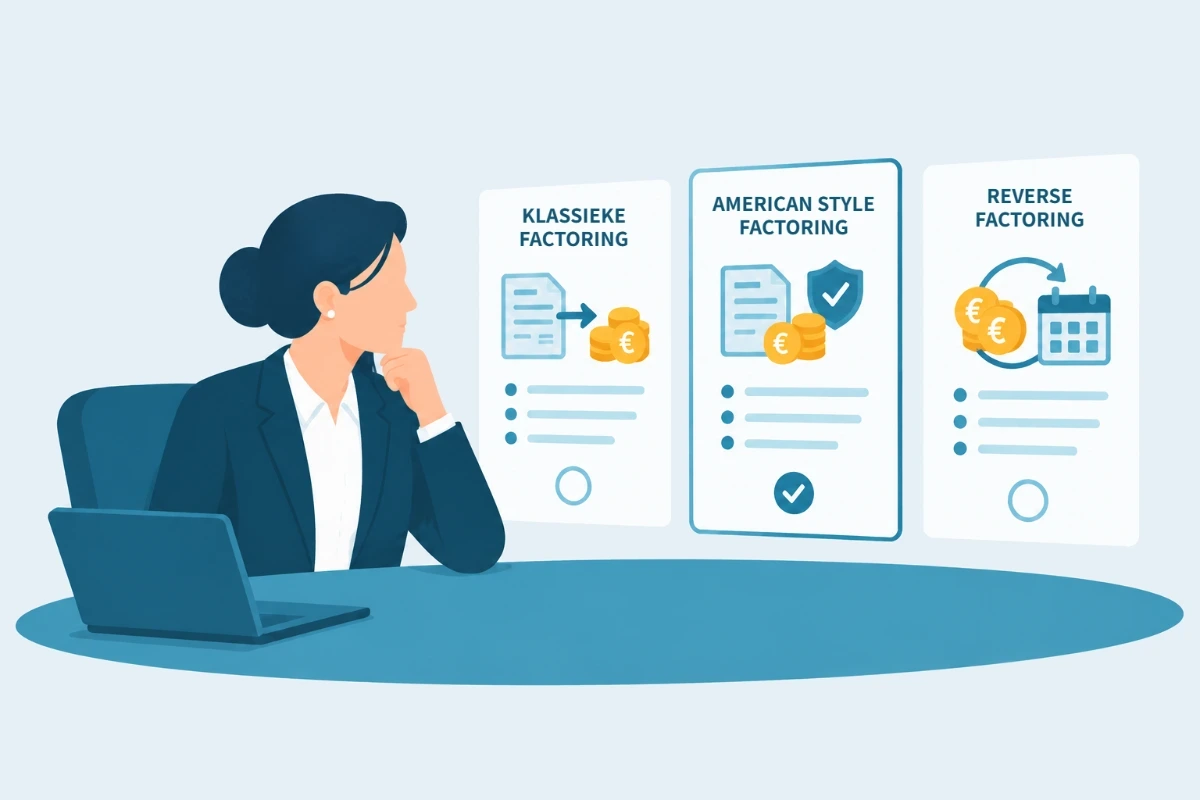
The five types of factoring at a glance
First, a quick overview. Each type is explained in more detail below.
| Type | How it works | Right for you if |
| Traditional factoring | You sell all your invoices to a factoring company. You usually get an advance of 60% to 90%. | you have many customers and at least €100,000 in annual revenue. |
| American Style factoring | You choose which invoices to sell. You get an advance of up to 98%. | one customer accounts for more than a third of your revenue, or you want to choose which customers go into the factoring agreement. |
| Single invoice factoring | You sell one invoice or a batch of invoices, with no ongoing contract. | you don't want a long-term contract or your revenue is too low. |
| Reverse factoring | Your supplier finances the invoices they send you through factoring. You get more time to pay. | you sell to consumers, or you run a large company with many suppliers. |
| Export factoring | You get an advance on invoices to customers abroad. | you have customers in other EU countries. |
Traditional factoring
With traditional factoring, you sell all your invoices to a factoring company. This covers invoices to businesses and to government agencies. You usually get 60% to 90% of the amount right away as an advance. The rest follows when your customer pays.
You decide whether the factoring company also handles your collections. If so, it follows up on your invoices and sends reminders. Already have collections well under control? Then you leave it out of the quote and take only the financing. Since the factoring company finances your invoices, it still keeps an eye on them. If a customer pays late, it lets you know.
You pay a factoring fee on your revenue and interest on the advance. For the numbers, see our page on what factoring costs.
How much revenue you need depends on who offers the factoring. The big banks usually require at least 3 to 4 million euros a year. Our partners, on the other hand, start at €100,000 in annual revenue.
Recourse and non-recourse factoring
What if your customer doesn't pay? Your contract says who bears the loss.
With recourse: you carry the risk. If your customer doesn't pay, you pay back the advance.
Non-recourse: the factoring company carries the risk, usually through credit insurance. That applies when your customer can't pay. If they refuse to pay because they're unhappy, that's usually not covered.
Undisclosed and disclosed factoring
With disclosed factoring, your customer knows you work with a factoring company and pays the factoring company directly. With undisclosed factoring, your customer notices nothing.
Undisclosed factoring is only available to very large, financially strong companies. For SMEs and startups, factoring is disclosed in practice.
American Style factoring
With American Style factoring, you choose which invoices or customers to finance. You get up to 98% of the amount right away. You pay one price per invoice, usually between 1% and 5%. It covers everything: the financing, collections, and credit insurance.
No credit insurance, no American Style factoring. The factoring company only finances invoices to customers the insurer approves a limit for. That limit is the amount the insurer is willing to cover for that customer.
You'll find this type mostly at fintechs. It's right for you if one customer accounts for more than a third of your revenue, since traditional factoring is usually not an option then. It's also a good fit if you want to choose which invoices you sell.
Single invoice factoring
Waiting on payment for one large invoice? You can sell just that invoice, or bundle a few together. There's no ongoing contract to sign.
The amount has to be at least €2,000. You get the full amount minus the factoring fee. In construction, the advance is capped at 50%.
Here too, a credit insurer looks at your customer. If it won't cover them, the invoice can't be sold. You apply for single invoice factoring through Nextfactor, and we put the file together for you.
Reverse factoring
Reverse factoring turns things around. Instead of you financing your invoices, your supplier finances the ones they send you. Your supplier gets paid right away. You get more time to pay.
That mainly helps SMEs that sell to consumers. If you invoice consumers, you usually can't use factoring. Reverse factoring still gives you breathing room. To set it up, we sit down with your suppliers.
We also help large companies set up reverse factoring for their suppliers.
Export factoring
Do you sell to businesses in other EU countries? Those invoices can be financed through our partners too. That's called export factoring. You get an advance, and the factoring company follows up with your foreign customers.
Which type of factoring is right for you?
Do any of these situations sound familiar?
| Your situation | What fits |
| You have many customers and at least €100,000 in annual revenue. No single customer accounts for more than a third of it. | Traditional factoring |
| One customer accounts for more than a third of your revenue. | American Style factoring |
| You want to choose which invoices you sell. | American Style factoring |
| You're waiting on one large invoice of at least €2,000 and don't want an ongoing contract. | Single invoice factoring |
| You sell to consumers and want to pay your suppliers later. | Reverse factoring |
| You're a large company and want your suppliers paid faster. | Reverse factoring |
| You have customers in other EU countries. | Export factoring |
Still not sure? We'll look at your situation together and tell you honestly which type fits.
Frequently asked questions about types of factoring
Don't see your question? See all FAQs.
With traditional factoring, you sell all your invoices and pay a factoring fee plus interest. With American Style factoring, you choose which invoices to sell and pay one all-in price per invoice.
It depends on your business. Traditional factoring often has a lower percentage, but you also pay interest and sometimes fixed fees. So always compare what you pay in total. Read more on our page about what factoring costs.
If your customer doesn't pay, the factoring company bears the loss, not you. There's usually credit insurance behind it. That applies when your customer can't pay. If they refuse to pay because they're unhappy, that's usually not covered.
In practice, no. Undisclosed factoring is only for very large, financially strong companies. For SMEs and startups, factoring is disclosed: your customer knows you work with a factoring company.
Yes, with single invoice factoring. The amount has to be at least €2,000. Your customer does need to be insurable with a credit insurer.
Not sure which type of factoring is right for you?
Each type has its own conditions. Each partner has its own rules. Tell us how your business works, and we'll tell you which type fits and with which partner.